Monday, 5 August 2013

HEROS OF SARAWAK

HEROES OF SARAWAK


 RENTAP 
 Sarawak was once a ruled country by the Sultan of Brunei, but have been given to James Brooke for his service and he than expand his empire. Back then, life was hard and not a place where we dream of living. people in Sarawak then realise that they want Freedom and Justice. But the most is what they want is INDEPENDENCE. As the time flow, one by one have rise and this is their story.


RENTAP
The Iban chief of Bukit Sadong fame

His original name was Libau but well-known by his short praise-name (ensumbar in Iban) Rentap. He was a Dayak (Iban) rebel leader in Sarawak, Malaysia during the Brooke White Rajah era. This made him the hero for the Iban Dayak in the State of Sarawak, Malaysia, located at the western part of the Borneo Island. "Rentap" in Iban means the "World-shaker". He was proclaimed by his followers as "Raja Darat" (King of Land) or "Raja Ulu" (King of Upriver) at the height of his power at his Sadok Hill fort. Rentap became well-known when he was selected to be one of the leading fighting men for a great war leader, Orang Kaya Pemancha Dana "Bayang" who led war expeditions to the areas around the mouth of Kapuas River in West Kalimantan, Indonesia. This by chance prepared the young warrior Rentap with war experience in fighting James Brooke later on in his life especially at Sadok Hill until his death in hiding in 1870.

Timpang Brang, or the one armed cannon used by Rentap's forces to defend the fort on Bukit Sadok


This cannon ball was found recently when the longhouse was moved, it is to big to have come from the cannon used by Rentap, most likely it would have come from the "Bujang Sadok" that is the 12 pound cannon brought to the mountain by the Brooke forces.
Replica of Rentap's cannon standing on top of the mountain.


ROSLI DHOBI

who assasinated the second British governor Sir Duncan Stewart in 1949.

Rosli Dhobi was born in 1932 in Kampung Siong, Sibu, Kingdom of Sarawak. Rosli started his career as a teacher and quit his job in 1947 in order to teach in Sibu People's School. Rosli was known to be a nationalist and a poet. Using the nickname Lidros, Rosli penned down a nationalistic poem titled 'Panggilan Mu yang Suchi' which was published in Utusan Sarawak on February 28, 1948. The usage of nickname was prevalent at the time since the British Colonial Authority vigorously monitored any attempts to spread words against them. Rosli joined Rukun 13 in August, 1948. He was introduced to the organization by an old friend, Bujang SuntongIt was a secret cell organization, composed of nationalists and patriots, which carried out assassinations of officers of the British Colonizer in Sarawak. He was well known for his assassination of Sir Duncan George Stewart, the second governor of colonial Sarawak in 1948. After a few months languishing in prison, Rosli Dhoby, Awang Ramli Amit Mohd Deli, Morshidi Sidek and Bujang Suntong were found guilty of murder and sentenced to death on December 4, 1949.

MAKAM ROSLI DHOBI 


SHARIF MASAHOR

The melanau warrior
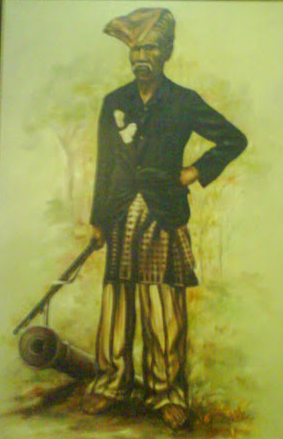
Sharif Masahor was also known as Sayyid Mashhur bin Muhammad Al-Shahab. Before the arrival of James Brooke, he was a powerful member who ruled and, in the past, like Datu Patinggi Abdul Gapur, he was very influential and respected due to both his charisma in uniting the people of different races and beliefs, and also due to his lineage. James Brooke's expansion policy caused disturbance in many parts of Borneo.  Brooke's encroachment into local leaders' territory caused many locals to rebel, including Syarif Masahor. In July 1859, Masahor and his army attacked Brooke's outpost near Bukit Rejang in Kanowit. During this attack, officers Charles Fox and Henry Steele were killed by Melanau people led by Sawing and Sakalai. This angered the British people throughout Kuching following the rebellion by the Chinese people. In early 1860, Masahor ordered Temenggung Hayim Jalil from Brunei to go to Pontianak for a meeting with Abdul Gapur. In early February 1860 they mounted an assault on Kuching (at that time, Sarawak), according to Masahor's plan. Masahor and his army wanted to approach Kuching via the Sarawak River. In the battle that ensued, the British forces gained the upper hand when Charles Brooke succeeded in ambushing and destroying all Masahor's ships. Facing defeat, Masahor retreated to Brunei, where he would seek shelter from the British. However, in 1861, James Brooke went to Brunei, in hopes of forcing the Sultan of Brunei to banish Syarif Masahor to Selangor once and for all. Masahor eventually arrived at Klang, where he became an adviser to Sultan Abdul SamadDuring the Klang War however, Syarif Masahor sided with the rebellious Klang territorial chief Raja Mahadi who did not recognise Sultan Abdul Samad's rule. Abdul Samad sought British help to win the war, and Masahor ended up fighting against the British for a second time. Nevertheless, after the surrender of Raja Mahadi and Syarif Masahor, they were both pardoned by Abdul Samad. Syarif Masahor died in Kerling, Selangor in 1890 and was buried there.


LIU SHAN BANG

leader of the 1857 Chinese Uprising
The reforming Brooke administration had angered the Bau(part of Sarawak) miners & the Twelve Kongsi, and thus a rebellion was started against the White Rajah. The rebellion was initiated in 1857 at Tian Tsze Lung Kung in Bau by Liu Shan Bang, the leader of the Twelve Kongsi. 600 armed miners, without proper weapons & military training, paddled down the Sarawak River & attacked the Astana. James Brooke escaped the assault. Five Europeans were killed, and one was mistaken to be James Brooke. With no political will & planning the Chinese miners stayed or ruled Kuching for 3 days before returning to their base. By then, James Brooke had already been given time for retaliation. The counter attacks by Brooke’s army, with combined forces of Skrang Iban warriors & Malays loyal to him, defeated the Chinese miners badly. In Jugan Siniawan, more than a hundred miners were killed; including the leader Liu Shan Bang himself.
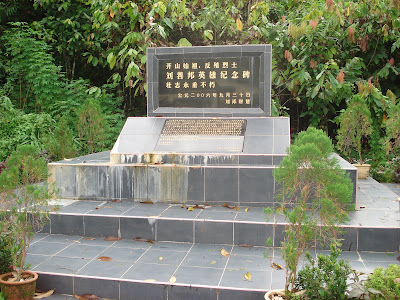
A memorial monument for the local hero, Liu Shan Bang, during the 1857 Chinese Insurrection against the Brooke Administration. The 1857 tragedy is a forgotten sad history especially for the local Bau Chinese. This temple was the center of activities of Liu Shan Bang, his associates, and the Twelve Kongsi (the gold mining company).

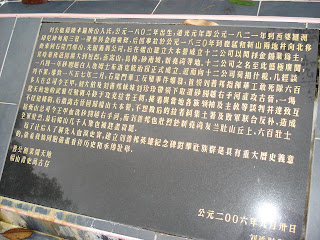
Notes on the history of the hero, Liu Shan Bang, the Twelve Kongsi, the Bau gold mining, and the 1857 incident. It was believed that the Twelve Kongsi actually ruled Sarawak for 3 days before the Brooke Administration retaliated.
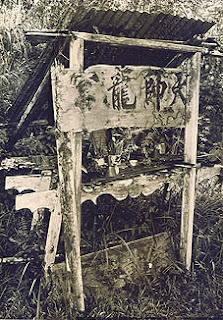
The remains of the old Tian Tsze Lung Kung, photo taken in the 1970s. Source: International Times, Sarawak.


DATUK PATINGGI ALI 


Datuk Patinggi Ali was a principal leader of the Sarawak Malays who fought against the Brunei Government during the rule of Pengiran Makota and Raja Muda Hasim, most probably between 1837 and 1840. He surrendered in December, 1840 on the understanding that James Brooke would hence forth become the Raja and stop the Brunei Pengirans from oppressing them.After James Brooke was declared Raja and the Governor of Sarawak on 24th.September, 1841 and he reinstated Datu Patinggi Ali as a leader of the Sarawak Malays. From 1841 to 1844 he served James Brooke as a famous fighting man for the government.


SPECIAL FOOD OF SARAWAK

 SPECIAL FOOD OF SARAWAK 

LAKSA
Laksa typically consists of rice noodles in a thick, gritty gravy made from either coconut milk and curry paste or tamarind fruit and fish, depending on the locale. Lemongrass, garlic, shallots, chili, fish or shrimp, and a long list of other seasonings blend flawlessly for a complex taste. Optional lime helps to counter the fishy taste and adds a citrus zing.
Laksa is the quintessential fusion of Chinese and Malay cuisine; a must-try for any traveler in Southeast Asia.

The Origins of Laksa

Laksa is generally thought to be a creation of the Chinese who immigrated to the British Straits in Malaysia during the 15th century. Known as the Peranakan, most of the immigrants were of Hokkien descent and came from South China.
Even the origin of the word "laksa" is debated. The word lakhshah denotes a type of noodle in Hindi; however, laksa sounds similar to a Chinese word meaning "spicy sand" - fitting because of laksa's gritty texture.
LAKSA SARAWAK 
taken in : http://goseasia.about.com/od/malaysianculturepeople/a/laksa_noodles.htm
MEE KOLOK 
Mee Kolok was originally not the original natives of Sarawak foodMee Kolok is those foods brought by migrant The Sarawak Chinese community migrated to The SarawakAs a result many Kolok mee is served in all the chinese food storein the state. Mee Mee Kolok between popular self in Sarawakand is well known among the Malays, however not manyMalay food outlets serving Kolok mee and there is a slight modification of taste.
There are several terms that refer to Kolok mee.

(i) Mee Kolok (Malay)
(ii) Kampua (Chinese)
(iii) Outline noodles / 'dry noodles(Iban)
 
MEE KOLOK 


MEE KUCHING AND KUEH TIAW TOMATO 


Both types of noodles are readily available in Chinese food stores, and restaurant or food 

courts (halal) in the shopping complex. 
For Kuching Noodles, noodles are widely available in Kuching and it also known as Mee Wire.

 This is due to hard and crunchy noodles when served. 

MEE WIRE

KUEH TIAW TOMATO 


MANOK PANSOH 

Pansoh Manok in which chicken is a type of food cooked in bambooThis food is traditional food of the Iban communitySupplying the same manner as provided in the peninsula bamboo cylinder.
'Manok' means chicken and 'Pansoh' means cooked in bambooIn the Iban languageknown as 'Manuk Pansuhor 'Manuk Lulun'. Due to this method of cooking originated from the Iban community, then other ingredients other poultry such as pork and fish prepared in the same manner.

WAY TO DO MANOK PANSOH
MANOK PANSOH THAT ALREADY COOK 


TEBALOI 
 Tebaloi is a type of biscuit which is a kind of consolation traditional Melanau foodTebaloi main ingredient is a consolationThese foods are widely exported to other countries and is one of the traditional food The Sarawak which are in high demand.
VIEW OF TEBALOI WHEN IT ALREADY PACK
PROCESS HOW TO CUT THE TEBALOI 


KEK LAPIS SARAWAK 

Sarawak layer cake is a cake / pastry popular in Sarawak. These cakes are very popular during celebrations in Sarawak eg Eid, Christmas, Gawai Dayak, and do not miss the Chinese New Year. This cake has dozens of patterns or pattern and each type has its own unique name created by people who first created the pattern or pattern cake. Prices also depend on the large cake, patterns and difficulty making the cake. So the bigger, the more the pattern, the more difficult to make the cake, the more expensive the price of the cake.

For example: type layer cake 'roll' with the usual pattern, size 8 "x 8" x 4 ", 3.5 kg priced at RM198.00 each. (Price based on one layer cake seller)

Here are some of the types and names layer cake::


TYPES OF ROLL
i. Kipas
ii. Kristal
iii. Bintik-bintik


iv. Batik Jiwa


COMMON TYPE 

i. Aiskrim Anika
ii. Ketupat
iii. Tulip
iv. Pua Kumba

taken in : http://kuchinghereicome.blogspot.com/2013/07/traditional-food-sarawak.html


UMAI 

Umai is a raw fish salad that’s particularly popular amongst the fishermen of Melanau, an ethnic group in Sarawak. It’s made with freshly-caught fish – typically mackerel, umpirang or bawal hitam – that’s been sliced into thin slivers. Additional ingredients include onions, chilli, salt and a satisfactory squeeze of lime or assam juice that gives the salad its signature sour taste. This interesting side dish is best enjoyed with a serving of white rice.
Umai
Umai, a popular raw fish salad from Kuching.

- See more at: http://www.asiarooms.com/en/community/blog/5-famous-foods-in-kuching/#sthash.hhnUwsUq.dpuf


MIDIN 

As no diet would be balanced without your greens, I’ve decided to include the Midin in this listing. This delicious yet nutritious dish is prepared by stir-frying a species of fern that can only be found in the jungles of Sarawak, and it’s unique because it remains enjoyably crunchy even after it’s been cooked, unlike other vegetables that usually turn soft. Garlic, ginger or shrimp paste is introduced to add flavour to the dish.
Midin
Midin that has been stir-fried with sambal belacan.
- See more at: http://www.asiarooms.com/en/community/blog/5-famous-foods-in-kuching/#sthash.hhnUwsUq.dpuf

Sunday, 4 August 2013

RELIGIOUS OF SARAWAK

                        RELIGIONS OF  SARAWAK 

CHRISTIAN
Christianity is the most popular religion in Sarawak. Sarawak is the state with the highest percentage of Christians in Malaysia. According to 2010 census, Christian make up 42.6% of total population of Sarawak. Major Christian denominations in Sarawak are the Roman Catholics, Anglicans, Methodists, Borneo Evangelical Church (or Sidang Injil Borneo, S.I.B.) and Baptists. Many Sarawakian Christians are non-Malay Bumiputera, ranging from Iban, Bidayuh, Orang Ulu and Melanau.
Denomination of Christians in Sarawak may vary according to their race, although this is not necessarily true. For example, most Chinese Christians are Methodists, most Ibans and Bidayuhs are either Roman Catholics or Anglicans, whilst most Orang Ulu are S.I.B.s. Church plays an important part in shaping morality of the communities, while some Christians view the church as a religious place. Professing Christianity has led to abolishing of some previous rituals by indigenous ethnics such as headhunting, improper disposal of dead bodies. Christians among indigenous ethnics have also embraced many Christian values such as preserving modesty and dedication to God.


Christianity has also contributed to the betterment of the education system in Sarawak. There were a lot of missionary schools built during 1950s to early 1980s. Christianity has gained popularity throughout Sarawak, transcending race and religion. Due to federalisation of the education system, most of these missionary schools have been converted into government national schools. Participation of the church in these schools has been reduced. The Malaysian government has allowed the schools to continue using religious symbols on school buildings and teaching Christian values to non-Muslim students.

Christians in Sarawak observe Christian festivals just like their counterparts in other part of the world, namely Christmas, Good Friday, Easter Monday and Ascension Day. However, only Christmas and Good Friday are public holidays in Sarawak.

ST.JOSEPH CHURCH FOR ROMAN CATHOLIC 
ST.THOMAS FOR ANGLICAN 

SEVENTH DAY ADVENTIST CHURCH FOR METHODIST 

HOLY BIBLE FOR ALL THE CHRISTIAN 


ISLAM 
Islam is the second largest religion in Sarawak. 23% of Sarawak population are Muslim by religion. Many Muslims in Sarawak are ethnic Malays. All Malays are designated Muslim by the Malaysian Constitution. Malay culture contributes significantly to Sarawakian Muslim tradition as a whole especially for weddings, circumcision (coming of age ritual), 'majlis doa selamat', etc.
Other ethnic groups which have strong Islamic influence in their traditions are Melanau and Kedayan. Melanaus, depending on region or kampung they live in, are normally either Muslim or Christian (while very little practising pagan). Most of them live in Kuching, Matu, Mukah, Igan and Bintulu. The majority of Melanau people are of Muslim faith.
Kedayan, is another distinct ethnic from Malay and Melanau, but traditionally Muslim. Although small in number, they contribute to a majority of Muslim population in Sibuti and Bekenu district.
Administratively, Islam is under the authority of the state of Islamic Council, which is Majlis Islam Sarawak (MIS), a state government agency. Under MIS, there are various agencies dealing with various aspects of Islam such as Jabatan Agama Islam Sarawak (JAIS), Majlis Fatwa, Baitulmal Sarawak etc.
Although the population of Muslims has increased over the past 40 years, their rate of growth has not matched that of the Christians.Despite being the state with highest growth of Muslim population in Malaysia, Sarawak may have the highest growth of apostasy among Muslim converts in Malaysia.
Muslims in Sarawak observe all Islamic festivals, such as Hari Raya Aidilfitri (Puasa), Hari Raya Aidiladha (Haji), Awal Muharram and Maulidur Rasul. All these celebrations have been commenced as public holidays in Sarawak. However, Israk Mikraj, Awal Ramadhan and Nuzul Quran, although observed, are not public holidays.
MASJID FOR MUSLIM

AL-QURAN FOR MUSLIM 

BUDDHISM/TAOISM
Buddhism is regarded as the main religion of the ethnic Chinese in Sarawak. Many of the Sarawakian Chinese community, which comprises the bulk of the Buddhist population, actually practise a mixture of Buddhism, Taoism and Chinese folk religion. As there is no official name for this particular set of beliefs, many followers instead list down their religion as Buddhism, mainly for bureaucratic convenience. Buddhists from other ethnic especially Bumiputera are rare and almost insignificant to be related with.
Buddhists in Sarawak observe Wesak Day. It is a public holiday in Sarawak.


TEMPLE FOR BUDDHA

HINDUISM 
Unlike their fellow Peninsular Malaysians, Sarawak Hindus are very small in number. Almost all Hindus in Sarawak are Indians, while some are Chinese and other indigenous people through inter-marriages. There are less than 10 Hindu temples throughout Sarawak, most of them are located in Kuching and Miri.
Hindus in Sarawak observe Deepavali and Thaipusam. However, none of these festivals are public holidays in Sarawak.
TEMPLE FOR HINDUISM 
THE BUDDHA DEWA
INSIDE THE TEMPLE 


SIKHISM 
The first Gurdwara was built in 1911 in Kuching, built by the Sikh community of pioneers in the state, mainly police and security personnel. At the present, there are four known Gurdwaras in the state, with one each located in Kuching, Miri, Sibu and Bau, with the latter no longer in existence since the late 1950s, due to the fact that there were no longer any Sikhs in that area.
Besides being used as places of worship, the Gurdwaras also hold weekly Gurmukhi classes and also serve as community centres for the thriving Sikh community.


TEMPLE FOR SIKH 

BAHA'I 
Baha'i is one of the recognised religions in Sarawak. Various races embraced the Baha'i Faith, from Chinese to Iban and Bidayuh, Bisayahs, Penans, Indians but not the Malays or other Muslims. In towns, the majority Baha'i community is often Chinese, but in rural communities, they are of all races, Ibans, Bidayuhs, etc. In some schools, Baha'i associations or clubs for students exist.
Baha'i communities are now found in all the various divisions of Sarawak. However, these communities do not accept assistance from government or other organisations for activities which are strictly for Baha'is. If, however, these services extend to include non-Baha'is also, e.g. education for children's classes adult literacy, then sometimes the community does accept assistance.
The administration of the Baha'i Faith is through local spiritual assemblies. There is no priesthood among the Baha'is. Election is held annually without nomination or electioneering. The Baha'is should study the community and seek those members who display mature experience, loyalty, are knowledgeable in the Faith.
There are more than 40,000 Baha'is in more than 250 localities in Sarawak.


ANIMISM
Many Dayak especially Iban continue to practice traditional ceremonies, particularly with dual marriage rites and during the important harvest and ancestral festivals such as Gawai Dayak, Gawai Kenyalang and Gawai Antu.
Other ethnics who still have trace number of animism followers are Melanau and Bidayuh.


taken in : http://en.wikipedia.org/wiki/Demographics_of_Sarawak#Religions_of_Sarawak

RACE OF SARAWAK

RACE : IBAN 

The Ibans comprise the largest percentage (almost 30%) of Sarawak's population. Iban is native to Sarawak and Sarawak has the highest number of Ibans in Borneo. Formerly reputed to be the most formidable headhunters on the island of Borneo, the Ibans of today are a generous, hospitable and placid people.
Because of their history as pirates and fishermen, Ibans were conventionally referred to as the "Sea Dayaks". The early Iban settlers migrated from Kalimantan, the Indonesian part of Borneo south of Sarawak, via the Kapuas River. They crossed over the Kelingkang range and set up home in the river valleys of Batang Ai, the Skrang River, Saribas, and the Rajang River. The Ibans dwell in longhouses, stilted structures with a large number of rooms housing a whole community of families.
An Iban longhouse may still display head trophies or antu pala. These suspended heads mark tribal victories and were a source of honour. The Dayak Iban ceased practising headhunting in the 1930s.
The Ibans are renowned for their Pua Kumbu (traditional Iban weavings), silver craft, wooden carvings and bead work. Iban tattoos, which were originally symbols of bravery among Iban warriors, have become amongst the most distinctive in the world.The Ibans are also famous for a sweet rice wine called tuak, which is served during big celebrations and festive occasions.
The large majority of Ibans practise Christianity. However, like most other ethnic groups in Sarawak, they still observe many of their traditional rituals and beliefs. Sarawak celebrates colourful festivals such as the Gawai Dayak (harvest festival), Gawai Kenyalang (hornbill, or the god of war festival), penuaian padi and Gawai Antu (festival of the dead).


VIEW OF THE LONGHOUSE AND ALL THE CULTURE THAT IBAN HAVE IN LONGHOUSE SUCH AS THE HEAD OF PEOPLE,TATOO AND THE BASKET THAT MADE FROM ROTAN.
THE PICTURE SHOWN A WOMEN MADE PUA KUMBU IN LONGHOUSE.SHE ALSO MADE DEMONSTRATION TO THE TOURISTS THAT COME TO THEIR LONGHOUSE.


RACE : BIDAYUH 

Concentrated mainly on the west end of Borneo, the Bidayuhs make up 8% of the population in Sarawak are now most numerous in the hill counties of Lundu, Bau, Penrissen,Padawan, Siburan and Serian, within an hour's drive from Kuching.
Historically, as other tribes were migrating into Sarawak and forming settlements including the Malays from the neighbouring archipelagos, the Bidayuhs retreated further inland, hence earning them the name of "Land Dayaks" or "land owners". The word Bidayuh in itself literally means "land people" in Biatah dialect. In Bau-Jagoi/Singai dialect, the pronunciation is "Bidoyoh" which also carry the same meaning.
The traditional community construction of the Bidayuh is the "baruk", a roundhouse that rises about 1.5 metres off the ground. It serves as the granary and the meeting house for the settlement's community. Longhouses were typical in the olden days, similar to that of the Ibans.
Typical of the Sarawak indigenous groups, the Bidayuhs are well known for their hospitality, and are reputed to be the best makers of tuak, or rice wine. Bidayuhs also use distilling methods to make “arak tonok”, a kind of moonshine.
The Bidayuhs speak a number of different but related dialects. Some Bidayuhs speak either English or Sarawak Malay as their main language. While some of them still practise traditional religions, the majority of modern-day Bidayuhs have adopted the Christian faith with a few villages embracing the Islamic faith as a minority group within the Bidayuh community.


THE LONGHOUSE FOR THE BIDAYUH.


                                                                              THE TRADITIONAL DRESS FOR BIDAYUH.

RACE : CHINESE 

Chinese people first came to Sarawak as traders and explorers in the 6th century. Today, they make up 24% of the population of Sarawak and consist of communities built from the economic migrants of the 19th and early 20th centuries.
The first Chinese (Hakka) migrants worked as labourers in the gold mines at Bau or on plantations. Through their clan associations, business acumen and work ethic, the Chinese organised themselves economically and rapidly dominated commerce. Today, the Chinese are amongst Sarawak's most prosperous ethnic groups.
The Sarawak Chinese belong to a wide range of dialect groups, the most significant being:
Whereas Hakka is spoken predominantly by the farmers in the interior, Hokkien and Teochew are the dominant dialects spoken within the major trading towns and among early traders and businessmen. Hainanese (a.k.a. Hailam) were well known as coffee-shop operators, the Henghua are famous as fishermen. The notable difference between those who presided in West Malaysia is the common use of Cantonese. Mandarin however was and still is the unifying language spoken by all the different dialectic groups in both East and West Malaysia.
The Chinese maintain their ethnic heritage and culture and celebrate all the major cultural festivals, most notably Chinese New Year, the Hungry Ghost Festival and Christmas. The Sarawak Chinese are predominantly Buddhists and Christians.


SOME OF THING THAT CHINESE NEED DURING THEIR CELEBRATION.


SOME OF LANTERNS DESIGN THAT USE DURING THE CHINESE CELEBRATION.


RACE : MELAYU 
The Malays make up 23% of the population in Sarawak. Traditionally fishermen, these seafaring people chose to form settlements on the banks of the many rivers of Sarawak. Today, many Malays have migrated to the cities where they are heavily involved in the public and private sectors and taken up various professions.
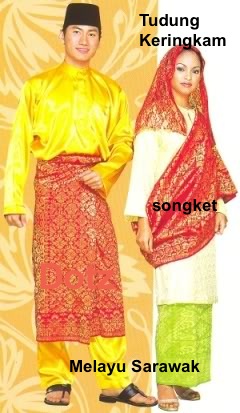
Malay villages, known as Kampungs, are a cluster of wooden houses on stilts, many of which are still located by rivers on the outskirts of major towns and cities, play home to traditional cottage industries. The Malays are famed for their wood carvings, silver and brass craftings as well as traditional Malay textile weaving with silver and gold thread (kain songket). Malay in Sarawak have a distinct dialect which is called "Melayu Sarawak" (in some official cases, it is recognized as a separate language). The culture of Sarawakian Malay is also somewhat unique such as 'bermukun', Sarawak zapin, and 'keringkam' weaving.
In Federal Constitution, Malays are Muslim by religion, having been converted to the faith some 600 years ago with the Islamification of the native region. Their religion is reflected in their culture and art and Islamic symbolism is evident in local architecture – from homes to government buildings. In Malaysia, for statistical purpose, Javanese and Bugis including some other Indonesian-origin ethnics like Banjar are categorized under Malay ethnic group.


SAMPLE OF MELAYU HOUSE  


                                                                                  TRADITIONAL DRESS FOR MELAYU IN SARAWAK 

RACE : MELANAU 

The Melanaus have been thought to be amongst the original settlers of Sarawak. They make up 6% of the population in Sarawak.
Originally from Mukah (the 10th Administrative Division as launched in March 2002), the Melanaus traditionally lived in tall houses. Nowadays, they have adopted a Malay lifestyle, living in kampong-type settlements. Traditionally, Melanaus were fishermen and still today, they are reputed as some of the finest boat-builders and craftsmen.
While the Melanaus are ethnically different from the Malays, their lifestyles and practices are quite similar. This is especially the case in the larger towns and cities where most Melanau have adopted the Islamic faith.
The Melanaus were believed to originally summon spirits in a practice verging on paganism. Today most of the Melanaus community is Muslim whilst some remained Christians, though they still celebrate traditional animist festivals such as the annual Kaul Festival.


SAMPLE OF MELANAU HOUSE 
                                    SAMPLE OF THE DANCE PERFORM BY ETHNIC MELANAU 

RACE : SALOKA AND LARA 
This ethnic group forms a small minority with very little or no comprehensive studies done by any party on their dialect, culture/customs and history. Although classified as Bidayuh by the Malaysian government for political convenience, the Salako and Lara culture have nothing in common with the other Bidayuh groups and their oral tradition claim different descent and migration histories. It is understandable that since this group is living within Bidayuh-majority areas and the fact that they also prefer to stay in one permanent inland area, most probably for agricultural reasons instead of branching out to other locations as opposed to the other races, they are grouped together as Land Dayaks.
This tribal community is believed to have originated from Gajing Mountain, at the source of Salakau River, near Singkawang in West Kalimantan, Indonesia. Their language is completely different and not intelligible with the other spoken Bidayuh dialects in the other districts. They are mainly found concentrated in the Lundu area. In August 2001, the Salako and Lara community set up the Salako-Lara Association to safe guard and preserve their culture and custom for the future generations. 


                                                                                                                                                                          SOME OF SALAKO & LARA TRADITION 


TRADITIONAL DRESS FOR SALAKO ETHNIC.


RACE : ORANG ULU 
Orang Ulu is a group of ethnics in Sarawak. The various Orang Ulu ethnics together make up roughly 5% of Sarawak's population. The phraseOrang Ulu means upriver people and is a term used to collectively describe the numerous tribes that live upriver in Sarawak's vast interior. Such groups include the major Kayan and Kenyah tribes, and the smaller neighbouring groups of the Kajang, Kejaman, Punan, Ukit, and Penan. Nowadays, the definition also includes the down-river tribes of the Lun Bawang, Lun Dayeh, "mean upriver" or "far upstream", Berawan, Saban as well as the plateau-dwelling Kelabits. Orang Ulu is a term coined officially by the government to identify several ethnics and sub-ethnics who live mostly at the upriver and uphill areas of Sarawak. Most of them live in the district of Baram[ Miri, Belaga, Limbang and Lawas.
The Orang Ulu are artistic people with longhouses elaborately decorated with murals and woodcarvings They are also well known for their intricate beadwork and detailed tattoos. The Orang Ulu tribe can also be identified by theirunique musical sound made by a sapeh, a stringed instrument similar to a mandolin.
A vast majority of the Orang Ulu tribe are Christians but traditional religions are still practised in some areas.


TOTEM POLE OG ORANG ULU 
EXAMPLE HOUSE OF ORANG ULU 

RACE : KAYAN 

There are approximately 15,000 Kayans in Sarawak. The Kayan tribe built their longhouses in the northern interiors of Sarawak midway on the Baram River, the upper Rejang River and the lower Tubau River, and were traditionally headhunters.
They are well known for their boat making skills. The Kayan people carve from a single block of belian, the strongest of the tropical hardwoods.
Although many Kayan have become Christians, some still practise paganistic beliefs, but this is becoming more rare.


KAYAN WOMEN ON THAT TIME USE ALL THE LONG  AND HEAVY EARING AND TIGHT HAND RING.IN THEIR RELIABLE THE MANY AND THE MORE THAT STAFF ARE USED THEY CAN BE MOREST BEAUTIFUL. 


                                                                                         TRADITIONAL DRESS FOR KAYAN ETHNIC.

RACE : PENAN 


The Penan are the only true nomadic people in Sarawak and are amongst the last of the world's hunter-gatherers. The Penan make their home under the rainforest canopy, deep within the vast expanse of Sarawak's jungles. Even today, the Penan continue to roam the rainforest hunting wild boar and deer with blowpipes.
The Penan are skilled weavers and make high-quality rattan baskets and mats. The traditional Penan religion worships a supreme god called Bungan. However, the increasing number who have abandoned the nomadic lifestyle for settlement in longhouses have converted to Christianity.


HOUSE OF PENAN ETHNIC.


                           ONE OF PENAN MALE WITH HIS HUNTING GEAR.


RACE : SEBOB/CHEBOB 

One of the least known tribes in Sarawak and can be found in upper Tinjar river. Sebob are the first Tinjar settlers along the Tinjar river and it is said that others migrated at a later date. The Sebob/Chebob tribes occupies up to six longhouse in Tinjar including Long Loyang, Long Batan, Long Selapun, Long Pejawai and Long Subeng. Amongst the longhouses, Long Luyang is the longest and most populated Sebob/Chebob settlement. It comprises almost 100 units. Most of these people have migrated and found work in the cities


RACE : INDIAN

The Indians in Sarawak are a small community, estimated to be between 5000 & 7000 people (figure also includes those of mixed parentage & professionals/students/residents from other parts of Malaysia) found mainly in the urban exteriors of Kuching & Miri division. The Indians encompass a wide spectrum of religions, being represented in the Hindu, Muslim (from Tamil Naidu, Malabari & Andhra Pradesh subethnic groups), Christian, Sikh, Buddhist & Baha'i faiths.
The Sikhs were among the earliest Indians to set foot on Sarawak's soil, recruited by the first White Rajah, Sir James Brooke in Singapore as police officers to bring peace, law and order during the 1857 Chinese uprising in Bau. At a much later stage, the Sikhs were employed as security personnel for the Sarawak Shell Company in Miri & also as government-appointed prison wardens. It is also believed that there were a few Sikhs in the Sarawak Rangers, which was formed in 1872. As for the Tamil, Malayali, Sindh & other Indian ethnic groups, their history in the state began during the 1860s, when they were brought in from South India by the second White Rajah Charles Brooke to work in the tea & coffee plantations in the Matang Hills. There were also traders & travellers visiting the state for religious, educational or business opportunities. After many years, the Indian community is extended to include newer immigrants from Sri Lanka & other areas in India. The Indian Muslims were prominent in the restaurant business, textile trade & Indian food production. They were also instrumentally significant in their contribution to the Islamic fellowship & religious welfare in the state with their Muslim Malay brethren.
Many of the present-day Sarawak Indians are from mixed marriages with the Malays, Chinese & other Sarawak native ethnic groups, with many of the younger generation using English, Sarawak Malay or one of the native or Chinese dialects to communicate with everybody else. They have assimilated well within the state's general population as a culturally distinct group in Sarawak that is rather unique as opposed to the Indian diaspora of Peninsular Malaysia & the Asian region in general. A number of Sarawak Indians can be found working as doctors, lawyers, engineers, teachers & other professional careers in the government & private sectors. 
VIEW OF INDIAN PEOPLE.

RACE : EURASIAN 
Mixed marriages/unions between Europeans and local spouses have been going on for centuries, since the time European traders, sailors and colonists first set foot on Sarawak's soils.
The Eurasians in Sarawak continues to be the smallest of minorities, with many of them rather identifying themselves with the major racial denomination of their local parent rather than that of their European, Australian or American parent, as the local state government does not formally classify them as an official ethnicity. At the moment, the exact number of people in the local Eurasian community is not known, as many of them registered themselves (for administrative and social ease) as Iban, Bidayuh, Chinese, Malay, Melanau, Orang Ulu, Indian or simply under "others". Besides assimilating themselves into the general populace, many of them had also migrated to Peninsular Malaysia or their foreign parents' countries of origin.
The local Eurasians established the Sarawak Eurasian Association(SEA) in the year 2000 to foster closer ties among members of this community and also to raise awareness on the existence of this distinct group. Their association is quite unique, if compared to the Eurasian associations of Peninsular Malaysia, as it is composed by members of different religious faiths.


RACE : BISAYA 
The Bisaya are an indigenous people, concentrated around the Limbang river in northern Sarawak state. Most Sarawakian Bisaya are Christians. They are distantly related to the Visayan of the Philippines, though their dialect is more related to Bahasa Melayu than the Philippine Visaya language. Such similarities may be due to the standardising effect and influence Bahasa Melayu had over not just the Borneon Bisaya but also all other ethnic languages spoken in Malaysia.
Bisaya’s indigenous people settled in Borneo thousand of years ago. The Bisaya were a people who were loved, feared and respected by the others. They are skilled in agriculture such as paddy planting, ginger, sago, local ginger, tapioca, banana, yam, pepper, coconut, and so on. They also hunt animals and breed others such as chicken, duck, goose, goat, buffalo, cow and many more. Bisaya people are also skilled in catching fish in the river or sea, and they can hold their breath under water for slighter longer periods without drowning.


RACE : JAVANESE 
The present generation are descended from the original ethnic Javanese people, the majority from the province of Central Java, who arrived in Sarawak as "kuli kontrak", indentured servants who were brought in by the Dutch via Batavia (modern-day Jakarta) during the late 1800s to the 1940s & transferred to a British company to work in the rubber plantations. After the end of their contracts, some of them had decided to settle down & work on land no longer producing rubber. Over the years, these labourers were prosperous & were later given the right of ownership to several hectares of land.
An estimated 50,000 Javanese people are found all over the state, establishing their own villages, with the majority concentrated in Kuching & its surrounding areas. Some of the younger generation still carry traditional Javanese names & are identified as ethnic Javanese in their birth certificates. They are proud of their heritage; the current population still speak the language of their parents & retaining their age-old traditions & practices of their forefathers.
The friendly Javanese are traditionally Muslims, so they have a strong affinity with the Malays, with many of them intermarrying & living within Malay-majority areas & also other communities. They use Sarawak Malay or English as a common lingua franca to communicate with the other ethnic groups.


RACE : BUGIS 
The Bugis are an ethnic group which had originated from the southwestern province of Sulawesi, Indonesia. They are renowned around the archipelago as adventurous seafarers and merchants, establishing trading routes with other ports along Sarawak's coastal areas over the past few centuries, eventually settling down with their families or taking up local spouses. The Bugis artisans are noted for their expertise in building tongkangs & proas, plying their skills at the fishing villages and local dockyards. They are also skilled farmers, construction workers, traders and fishermen.
The Bugis population in Sarawak is scattered throughout the state. Many can be found living along the coast alongside or within other communities and also opening up small agricultural settlements further inland, especially in the Sarikei district. They are predominantly Muslims and many have amalgamated with the local Muslim society through marriage.
RACE :  KEDAYAN 
The Kedayan are an ethnic group residing in parts of Sarawak. They are also known as Kadayan, Kadaian or simply badly spelled as Kadyan by the British. The Kedayan language is spoken by more than 37,000 people in Sarawak, with most of the members of the Kedayan community residing in Lawas, Limbang, Miri and Sibuti areas.
The origins of Kedayans are somewhat uncertain, with some Kedayans claiming to have Javanese origins. However, most researchers consider them indigenous to Borneo, having accepted Islam and influenced by Malay culture.
Kedayan are mainly padi farmers or fishermen. They have a reputation for knowledge of medicinal plants, which they grow to treat a wide range of ailments or to make tonics. The Kedayan tend to settle inland in a cluster pattern, with houses built in the center and with fields radiating outwards. The Kedayans traditionally tended to be a rather closed community, discouraging contact with outsiders. Intermarriage among relatives was encouraged for economic and social reasons.

RACE : PUNAN BAH 
Not to be confused with the Penan, the Punan Bah or Punan is a distinct ethnic group found in Sarawak, Malaysia. They are mostly found around the Bintulu area and also in Kalimantan, the Indonesian part of Borneo. They live on a mixed economy, engaging in swidden style of agriculture, with hill paddy as the main crop & supplemented by a range of other tropical plants. Hunting, fishing, and gathering of forest resources are the other important contributors to their economy. In recent times, many of the educated younger generation gradually migrated to urban areas such as Bintulu, Sibu, Kuching and Kuala Lumpur in search of better living & returning home occasionally, especially during major festivities such as Harvest Festival / or Bungan festival.
At the moment, the term Punan is often indiscrimately & collectively used to refer to the then unknown or yet to be classified tribes as such as Punan Busang, Penihing, Sajau Hovongan, Uheng Kareho, Merah, Aput, Tubu, Bukat, Ukit, Habongkot and Penyawung. There has been no effort to comprehensively study or research on this ensemble of tribes; these communities lack the privilege and are deprived of their rights to be recognized as individual & unique races (with their own tradition, language & cultural heritage) within the nation's list of ethnic classification, resulting to more than 20 different tribes / ethnics (unrelated to one another) found on the island of Borneo being lumped together into one ethnic group, which includes;
  • Punan Busang
  • Punan Penihing
  • Punan Batu
  • Punan Sajau
  • Punan Hovongan of Kapuas Hulu, West Kalimantan
  • Punan Uheng Kereho of Kapuas Hulu, West Kalimantan
  • Punan Murung of Murung Raya, Central Kalimantan
  • Punan Aoheng (Suku Dayak Pnihing) of East Kalimantan
  • Punan Merah (Siau)
  • Punan Aput
  • Punan Merap
  • Punan Tubu
  • Punan Ukit/Bukitan
  • Dayak Bukat
  • Punan Habongkot
  • Punan Panyawung


RACE : SULUK 

The Suluk people are one of the smallest minority groups in Sarawak, estimated at less than 200 people throughout the state. Their presence and existence were noted significantly after the illegal intrusion and terrorist act committed by Suluk gunmen from the southern part of the Philippines during the 2013 Lahad Datu standoff in Sabah.
They are believed to be descendants of the same ethnic group who had migrated from Sabah to Sarawak over the years. Most of the people within the Sulu community can be found living in Limbang, Lawas and Kuching areas. The vast majority of Suluk people are Muslims and very few are Roman Catholics.


 taken in : http://en.wikipedia.org/wiki/Demographics_of_Sarawak